From Windshield to Storefront: What Architectural Buyers Can Learn — and Unlearn — From Automotive Glass Standards
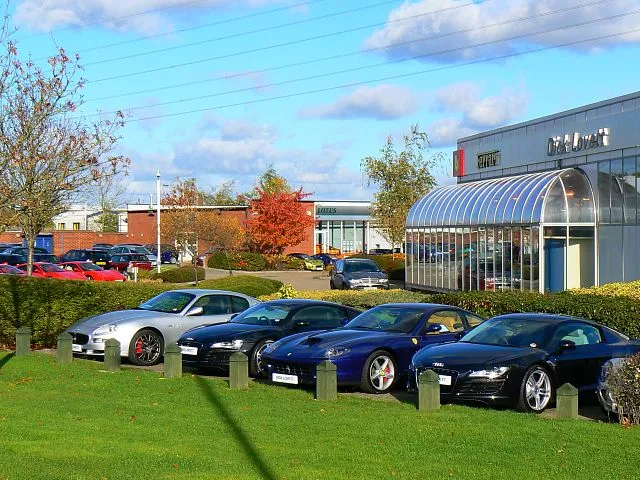
Photo: Brian Robert Marshall, CC BY-SA 2.0, via Wikimedia Commons
Walk any dealership lot in 2025 and you'll notice the trend immediately: glass everywhere. Full-length panoramic roofs, wraparound windshields, glass hatchbacks. Electric vehicle makers have made expansive glazing a centerpiece of their design language, and consumers have noticed. So it's no surprise that when a retail developer tours a completed EV showroom or a dealership with a glass canopy, the questions start coming back to us at the quoting stage: Why can't the storefront look like that? Why does the automotive glass look so clean? Can we just spec what the car companies use?
The short answer is no — but the longer answer is more interesting, and it matters for anyone buying tempered glass for commercial construction.
Two Industries, Two Rulebooks
Automotive glazing in the United States is governed by Federal Motor Vehicle Safety Standard (FMVSS) 205, which references ANSI/SAE Z26.1. Architectural safety glazing answers to a different authority entirely: CPSC 16 CFR 1201, referenced by the International Building Code (IBC) through ANSI Z97.1 for certain applications. These standards don't just differ in wording — they test fundamentally different failure scenarios.
FMVSS 205 is built around occupant survival in a crash: head containment, retention after impact, and visibility requirements. Architectural standards under 16 CFR 1201 are built around human body impact — a person walking, falling, or being pushed into a panel — with Category I and Category II classifications based on the amount of glass and the force of impact a panel must withstand.
This is why the "good enough for a car" logic breaks down. A tempered side window that passes FMVSS 205 may have never been evaluated against the 100 lb. and 400 lb. impact requirements that a commercial glass door or sidelight must meet under 1201 Cat II. The reverse is true as well. Neither certification is a substitute for the other, and building inspectors in the US will not accept an automotive rating in place of architectural compliance documentation.
Where the Auto Supply Chain Genuinely Raises the Bar
That said, there are real lessons construction buyers can import from automotive glass procurement — and we'd encourage it.
Optical quality control. Automakers reject panels for distortion levels that architectural buyers routinely tolerate. Roller wave, edge kink, and local bow are measured against tighter limits on a panoramic roof than on most storefront schedules we see. If your project involves curved glass, large vision panels, or anything adjacent to reflective interior finishes, borrowing automotive-grade optical tolerances into your spec is a legitimate upgrade — and one we've covered before in the context of retail glazing distortion.
Traceability. Every automotive glass part carries batch traceability back through the tempering furnace. When a field issue arises, the OEM can pull production records in hours. Commercial projects often settle for a stamp and a packing slip. Requesting furnace batch records and heat-soak documentation on architectural orders — especially for large-format tempered panels — is a low-cost hedge against the spontaneous breakage risks that nickel sulfide inclusions pose.
Zero-defect edge work. Automotive glass edges are machined to tolerances that eliminate the micro-chips and shell defects which, in architectural panels, become the seeds of premature thermal or mechanical failure. Specifying a fine-ground or polished edge with a documented inspection step costs little on the quote and buys real reliability.
Where Borrowing Stops Working
But the crossover has hard limits, and buyers who miss them end up in costly re-fabrication.
Thickness and heat treatment don't translate. Automotive glass is engineered for vehicle body stiffness, aerodynamics, and weight targets — often in thinner sections than architectural loads allow. A 3.5mm tempered roof panel has no bearing on whether a 10-foot storefront lite meets wind load requirements under ASCE 7 and the local building code.
Laminated vs. tempered decisions differ. Modern EVs increasingly favor laminated side glass for acoustics and occupant retention. In commercial work, the tempered-versus-laminated choice is driven by 1201 classification, post-breakage containment (critical for overhead and sloped glazing), and security requirements — not by crash dynamics.
Inspection authority is different. No AHJ (authority having jurisdiction) will sign off on architectural glazing based on automotive certifications. If your submittal package shows up with Z26.1 compliance where the IBC expects 16 CFR 1201 Category II documentation, expect a rejection and a schedule slip.
The Practical Takeaway for Buyers
The EV-driven elevation of consumer expectations is a real commercial force, and it's reasonable for your clients to demand showroom-quality optics and finish. The right way to deliver it is not to chase automotive glass, but to write automotive-grade quality requirements into an architectural-compliant product: tight optical distortion limits, documented heat-soak testing, certified edge work, and full traceability — all on panels certified to ANSI Z97.1 and CPSC 16 CFR 1201 as your project requires.
When you see a panoramic roof and think "that's the standard," you're half right. The standard worth adopting is the discipline, not the certification. Bring both ideas to your next glass supplier conversation, and make sure the spec sheet satisfies the inspector as thoroughly as it impresses the customer.