No Second Chances After the Furnace: Why Every Hole and Notch Must Exist Before Tempering
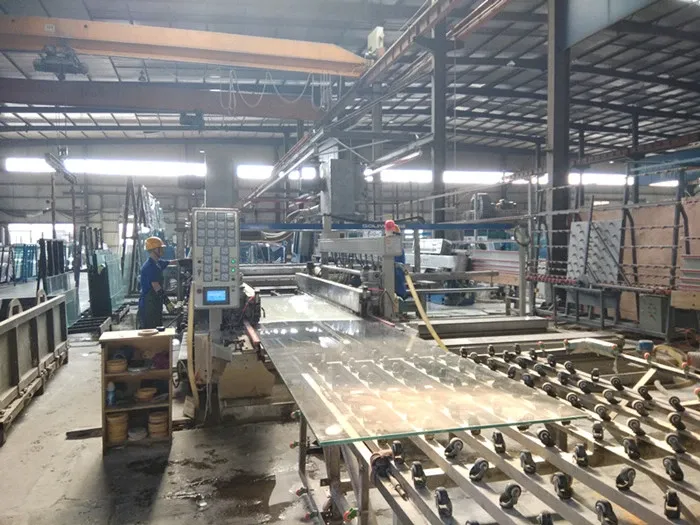
Photo: tempered glass panel with drilled holes industrial fabrication workshop, via cdn.cloudbf.com
The One-Way Door of Heat Treatment
Every fabricator has a story about the phone call that arrives too late: a contractor reviewing field dimensions, realizing the architect's revised door pull detail requires a new handle offset — and asking, almost apologetically, whether the shop can 'just drill a couple more holes' in the tempered panels already crated on the floor.
The answer is always the same, and it is never what the caller wants to hear. Once glass has been through the tempering furnace, it is a finished product in the truest sense. Cutting, drilling, edge-work, or sandblasting after tempering will shatter the panel — not occasionally, not with careful hands, but essentially every time.
Why the Physics Allows No Edits
Tempering works by heating glass to roughly 1,150°F and then quenching it rapidly with air. The outer surfaces cool and solidify first while the interior contracts later, locking the faces into compression and the core into tension. That engineered stress profile is what gives tempered glass its four-to-five-fold strength advantage over annealed glass and its characteristic small, granular break pattern required by safety glazing codes.
That same stress profile is why the panel is untouchable afterward. Any cutting or drilling operation breaks through the compressed surface layer and releases the stored tension in the core. The stress redistributes violently, and the panel disintegrates into fragments. There is no partial version of this outcome — no 'light touch-up' cut, no careful pilot hole.
This is why ASTM C1048, the standard governing heat-treated architectural glass in the United States, treats all mechanical fabrication as a pre-tempering operation. It is not a shop preference. It is baked into how the material is defined.
Where Buyers Get Burned
The expensive version of this lesson usually follows the same script:
- Drawings released early. A tempering order is issued based on a design development set, with hole patterns, notches, and cutouts dimensioned from that revision.
- The design moves. A hardware schedule is finalized, an MEP coordination clash forces a conduit relocation, or an architect revises a railing attachment detail during submittal review.
- The change surfaces late. By the time the revision reaches the glazing contractor, the panels are heat-treated, inspected, and possibly already delivered.
- The full cost lands. Replacement panels must be ordered, fabricated, tempered, and shipped — typically four to eight weeks of lead time — while the original panels become scrap the buyer effectively paid for twice.
On a storefront package or a glass railing system, that can mean tens of thousands of dollars plus a schedule slip that ripples into the punch-list and the certificate of occupancy.
The Pre-Order Fabrication Audit
The good news is that this failure mode is almost entirely preventable with a disciplined review before the purchase order is released. We recommend buyers and glazing contractors complete a short audit against the current, signed-off drawing set:
- Confirm the revision status. Verify that the drawings driving the order are the latest issued-for-construction set, and that no submittal or BIM coordination comments remain open.
- Locate every hole. Door hardware, standoffs, railing base shoes, spider fittings, sign standoffs — each requires a dimensioned hole location, diameter, and tolerance on the fabrication drawing.
- Check minimum distances. Holes must generally sit at least a specified distance from edges and from each other (commonly expressed as multiples of glass thickness). A hole too close to an edge can fail in the furnace or in service.
- Flag notches and cutouts. Corners of cutouts need radiused, not square, internal corners to resist crack initiation.
- Match hardware to glass. Confirm the actual hardware submittals — not the generic spec — against the hole pattern. Fittings are ordered around the glass, or the glass around the fittings, but never both independently.
- Freeze before release. Treat the fabrication drawing sign-off as a hard freeze. After tempering, a change is not a revision; it is a new order.
Make the Freeze Formal
Sophisticated buyers are increasingly adding a line to their glass purchase orders acknowledging that post-tempering fabrication is impossible and that the signed fabrication drawings are the controlling document. It sounds like a formality. In practice, it shifts the conversation when a change order arrives — from 'can the fabricator accommodate us?' to 'whose scope absorbed the design change?'
Tempering is one of the few building products where the manufacturing process itself enforces design finality. Respect that constraint, audit the drawings before the furnace does its work, and the panel that arrives on site will be the panel the building actually needs.