When Glass Breaks Itself: Nickel Sulfide Inclusions and the Case for Heat-Soak Testing
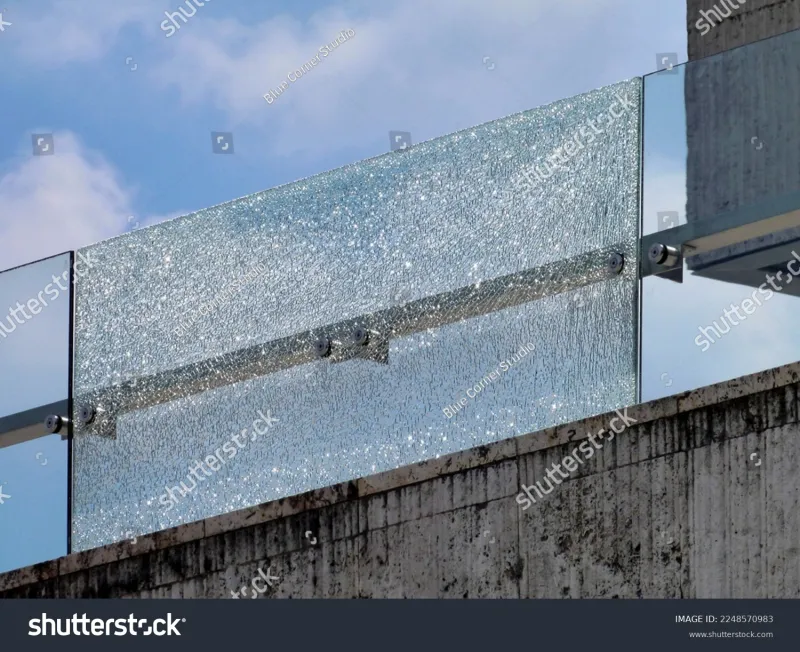
Photo: shattered tempered glass panel high rise building, via www.shutterstock.com
A tempered panel on the fortieth floor of a Chicago office tower lets go on a Saturday morning. No impact, no thermal stress event, no vandalism. The glass simply explodes into granular fragments, some of which drop toward the street. For the facility manager who fields the call, the first question is usually legal, not technical: who is responsible?
The technical answer often traces back to a contaminant measured in milligrams — a nickel sulfide (NiS) inclusion trapped inside the glass since it left the float line.
Why a Microscopic Speck Can Shatter a Panel
Float glass is manufactured from raw materials that can carry trace amounts of nickel. During melting, nickel can combine with sulfur to form microscopic inclusions — typically between 0.05 and 0.5 millimeters — dispersed through the glass body.
In annealed glass, these inclusions are largely inert. The problem emerges during tempering. To temper glass, a panel is heated to roughly 1,150°F and then rapidly quenched with air, locking the outer surfaces in compression and the core in tension. That tension is what gives tempered glass its four-to-five-fold strength advantage.
Nickel sulfide, however, undergoes its own phase change during cooling. The high-temperature crystalline form gets trapped when the quench cools the glass too quickly for the NiS to convert to its stable, lower-volume state. Over months or years, the inclusion slowly expands as it transforms. If the inclusion sits in the core tension zone of a tempered panel, that expansion can exceed the local tensile capacity — and the entire panel fails catastrophically, fragmenting into the small dice pattern the code expects.
Industry estimates put spontaneous NiS breakage at roughly one panel per several thousand tempered units, though rates vary widely with raw material sourcing and fabrication quality. For a high-rise curtain wall with 5,000 vision panels, even conservative odds are worth managing.
What Heat-Soak Testing Does — and What It Doesn't
Heat-soak testing accelerates the NiS phase transformation. Panels are reheated in an oven, held at approximately 555°F (290°C) for a defined period — typically two hours under the European EN 14179 standard — so that vulnerable inclusions convert and break the panel while it's still in the fabricator's shop rather than in your building.
The critical caveat: heat soaking is a probability reduction, not a guarantee. Not every NiS inclusion reaches its critical size during the soak cycle. Inclusion size, depth within the tension zone, and oven uniformity all affect whether a latent defect survives the test. EN 14179-certified heat-soaked glass dramatically lowers breakage risk, but no standard — American or European — promises zero spontaneous failures.
Which points to a gap in the US framework: there is no domestic ASTM equivalent mandating heat soaking. ANSI Z97.1 and CPSC 16 CFR 1201 govern impact safety performance, not NiS screening. Heat soaking in the American market is a specified option, not a code requirement — which means it only appears on projects where someone thought to ask for it.
The Liability Question After a Break
When a panel fails spontaneously, the resulting dispute typically turns on documentation. Facility managers should expect to preserve the failed panel and its fragments: forensic analysis of the fracture origin can confirm NiS inclusions under magnification, distinguishing them from edge damage, thermal shock, or impact.
Questions worth asking before the incident:
- Does the glass warranty address spontaneous breakage, or does it exclude "inherent glass defects"?
- Did the fabricator certify heat soaking, and can they produce oven records for the specific lite?
- Does the glazing contract include a drop-protection or overhead-glazing review for locations where falling fragments endanger people below?
In overhead and sloped glazing, and in locations subject to local falling-glass ordinances — New York City among them — the exposure extends beyond replacement cost to public safety and code compliance.
Procurement Language That Shifts the Risk
Spec writers can do more with a single paragraph than most warranties accomplish. Practical language for high-rise, overhead, and other failure-critical locations includes:
- Mandate heat soaking to EN 14179 or an equivalent documented cycle, with certification per project or per production lot.
- Require lot traceability, so oven records can be matched to installed lites years later.
- Specify heat-soaked, laminated construction where fragment retention matters — the interlayer holds debris in place even if breakage occurs.
- Define replacement logistics, including crane access and swing-stage provisions, before the first panel is installed.
Spontaneous breakage is rare, but it is not random — it follows metallurgy, not chance. The projects that avoid the Saturday morning phone call are the ones where the inclusion risk was addressed in the specification, not in the litigation.