Nominal on Paper, Off by a Millimeter: The Hidden Variability Behind 'Standard' Tempered Panel Sizes
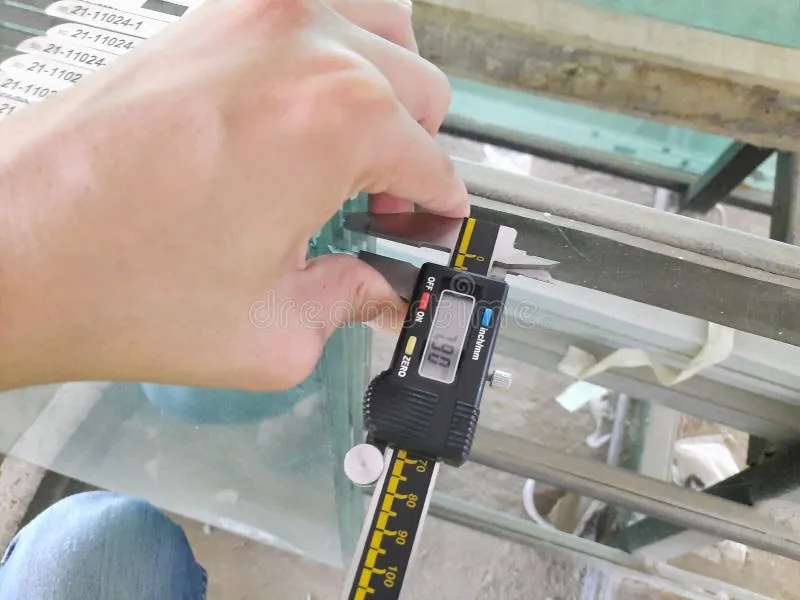
Photo: caliper measuring glass panel thickness fabrication workshop, via thumbs.dreamstime.com
A facilities manager in Ohio orders a replacement tempered panel for a 2011 storefront system, specifies 3/8-inch glass from a reputable fabricator, and waits for the crate to arrive. The panel is genuinely 3/8-inch — by every industry convention, it qualifies. It also doesn't fit. The rebate is tight, the drilled holes sit a quarter-inch off from the existing hinge pattern, and the notch that cleared the old panel's clamping block now interferes.
Nothing in that transaction was fraudulent. Both the original supplier and the replacement fabricator operated inside published tolerances. This is the quiet trap in tempered glass procurement: 'standard' sizes are nominal, not literal, and the gap between the two is where replacement orders go to die.
What '3/8-Inch' Actually Means
North American flat glass is sold by fractional designations that trace back to millimeter production sizes. A '3/8-inch' panel is, in practice, a 10mm panel — 0.394 inches, roughly 1.5mm thicker than the fraction implies. A '1/4-inch' panel is 6mm (0.236 inches), slightly under the nominal figure. '1/2-inch' glass is 12mm, a hair over 0.472 inches.
None of this is hidden. ASTM C1036, the standard governing flat glass thickness classes, defines these designations in millimeters, and ASTM C1048 extends the framework to heat-treated products. But a buyer working from a tape measure and a fraction chart will consistently misjudge what shows up at the dock.
The complication deepens because thickness tolerances run on top of the nominal size. Depending on the thickness class and fabrication method, a panel can deviate by tenths of a millimeter in either direction and still ship as conforming. Two fabricators drawing from different float lines can produce panels that differ measurably from each other while both sitting comfortably inside specification.
Tolerance Stacking: Where Replacement Orders Fall Apart
Thickness is only the opening act. Fabricated tempered panels carry a stack of independent tolerances — on length and width, on hole diameter and hole placement, on notch and cutout positions, on edge treatment, and on overall squareness. Each tolerance is reasonable in isolation. Summed across a panel with eight drilled holes and two notches, the cumulative deviation can easily exceed the clearance a framing system was designed around.
Consider a common scenario: a panel with holes dimensioned from a corner. Fabricator A dimensions hole locations from the left edge; fabricator B dimensions from the right. If the panel itself varies 1/16 inch from nominal width, every hole on B's panel shifts by that amount relative to A's — even with identical hole-to-edge callouts. Multiply by a curtain-wall system with forty panels and the mismatch becomes structural, not cosmetic.
Heat-treating adds its own wrinkle. Tempering cannot be performed after cutting or drilling, so every hole, notch, and cutout must be fabricated before the panel enters the furnace. There is no field correction. A mis-located hole in a tempered panel is scrap, and scrap on a replacement order means schedule loss on top of material cost.
The Pre-Order Checklist for Replacement Panels
Before a reorder goes out, buyers should treat the existing panel as the specification, not the original purchase order. A disciplined verification sequence looks like this:
- Measure actual thickness with calipers at three points on the panel, not with a fraction chart. Record the millimeter value and specify it explicitly on the RFQ.
- Dimension every hole from a single, agreed-upon datum — typically one corner — and state the datum on the drawing. Ambiguous datums are the most common source of hole-pattern mismatches.
- Specify hole diameter and edge distance explicitly, including whether holes are clearance-sized or sized for the fastener. Never let a fabricator 'match the standard.'
- Confirm notch and cutout positions from the same datum, with tolerances called out rather than left to shop default.
- Ask which float source and thickness class the fabricator will use, and whether they can hold tighter-than-standard tolerances where the frame demands it. Many can — but only if asked before the quote is issued.
- Request a fabrication drawing sign-off before release to production. On replacement work, this single step prevents most of the failures described above.
Writing Specs That Survive Fabricator Changes
For architects and spec writers, the lesson extends beyond replacements. A specification that says '3/8-inch tempered glass' delegates real decisions to whoever holds the purchase order. A specification that says '10mm tempered glass conforming to ASTM C1048, thickness class as measured, with hole patterns dimensioned from the lower-left corner at ±1/32 inch' survives a fabricator change, a supply disruption, and a value-engineering pass.
The broader principle is one this publication returns to often: in tempered glass procurement, the words on the drawing are the product. Nominal designations are a convenient shorthand for pricing and conversation — but when a panel must mate with existing framing, existing hardware, or an existing hole pattern, only measured dimensions and explicit tolerances constitute a real specification. The quarter-inch trap isn't a fabricator problem. It's a communication problem, and it's entirely preventable before the order leaves your desk.