Specifying the Edge You Actually Need: A Buyer's Guide to Grind, Polish, and Bevel Before the Quote Goes Out
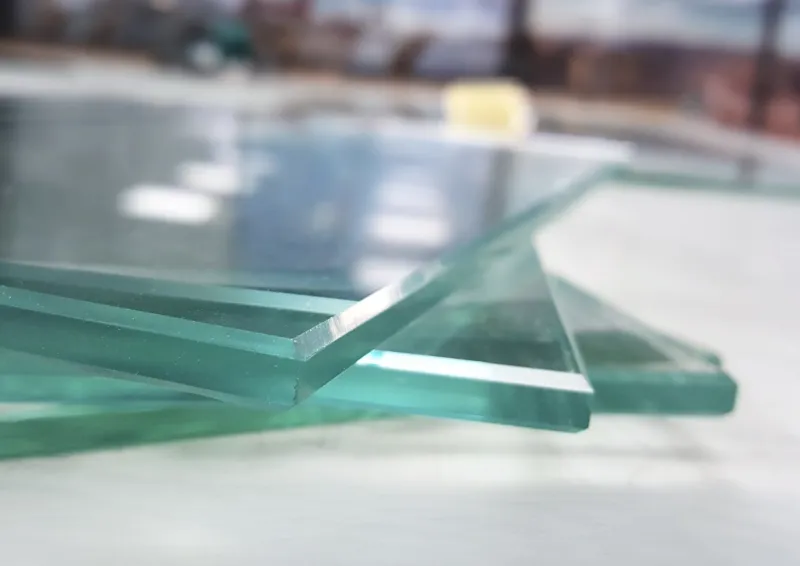
Photo: tempered glass edge polished close up fabrication workshop, via junoglass.co.uk
Ask ten fabricators to quote the same tempered glass project and you'll likely get ten different numbers. Some of that spread is freight and overhead. A surprising share of it, though, comes down to a line item that never appears in the RFQ at all: edge work.
Under ASTM C1048, a fully tempered lite must meet the same strength and fragmentation requirements regardless of how its edge is finished. That regulatory silence creates a loophole in practice. A coarse-ground edge and a fine-polished edge are both "compliant," but they are not interchangeable on your project — and if your purchase order doesn't say which one you want, the fabricator will choose for you.
Why the Edge Isn't Just Cosmetic
Tempering works by locking the glass surfaces and edges into compression. Any flaw introduced during cutting or handling — chips, shells, scratches from a rough grinding belt — becomes a potential failure origin once the panel is under bending stress. Edgework quality directly influences how much residual surface damage remains in that compressed zone.
For most interior partitions or framed lites, a standard grind is adequate because the frame covers the edge and shields it from impact. The calculus changes when the edge is doing structural work:
- Point-supported and spider fittings concentrate load at drilled holes and notches. A chip at a fitting can propagate under sustained stress, particularly in exterior applications subject to thermal cycling.
- Frameless entrances and all-glass railings put the edge in tension under wind and live loads. Glass railing codes in most US jurisdictions, including the IBC's laminated tempered requirements for guards, assume sound edge conditions.
- Table tops and counters rely on the edge for both strength and user safety — a raw seamed edge on a restaurant tabletop is a liability conversation waiting to happen.
The Menu: What Each Finish Actually Delivers
Seamed or ground (dry or wet): The workhorse. Removes cutting shards, leaves a matte, slightly rough edge. Cheapest, fastest, invisible in a frame. Fine for anything the glazing will hide.
Flat polished: A smooth, glossy vertical edge achieved with progressively finer wheels. Adds cost and cycle time, but it's the baseline for any exposed edge where clarity matters — frameless shower enclosures, glass canopies, display cases.
Pencil polish: A rounded, polished profile common on furniture tops and shelving. Comfortable to the touch, forgiving of minor handling. Slightly weaker in bending than a flat polished edge on thick lites because more material is removed.
Beveled: A decorative angled face, typically on the exposed perimeter. Purely aesthetic in most cases; bevels add setup cost and are best specified where the design genuinely calls for them, not as a default.
The Checklist Before You Send the RFQ
- Identify every edge on every lite. A single panel can legitimately need different treatments on different edges — polished verticals, a seamed top edge tucked under a header.
- **State the finish, not just "polished."" Specify flat vs. pencil, and whether all four edges or only visible ones.
- Call out holes, notches, and cutouts with tolerances. Hole placement relative to the edge is governed by fabricator minimums; confirm them in writing before release.
- Confirm edge work happens before tempering. Post-temper grinding destroys the panel. Any field modification request is a red flag.
- Match the finish to exposure. Exterior point-supported glazing warrants tighter edge quality standards than an interior transom; say so in the spec rather than leaving it to the shop.
The Cost of Silence
Fabricators price what they're told to price. When the PO arrives silent on edge work, the shop assumes the cheapest compliant option — and the difference surfaces later as a change order, a rejected delivery, or a panel that fails inspection because the architect expected a showpiece edge on a builder-grade budget.
A one-line edge specification costs nothing to write. Retroactively replacing a thousand square feet of glass costs considerably more. In tempered work, the edge is where strength, safety, and aesthetics converge — treat it as a spec item, not an assumption.