When Nothing Hit It: The Liability Vacuum Behind Spontaneous Glass Failures
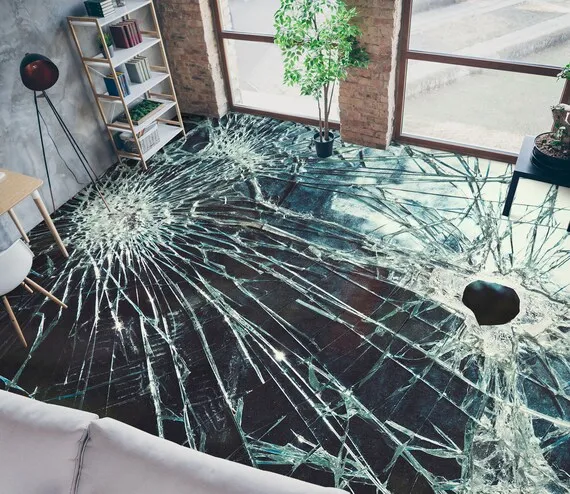
Photo: shattered tempered glass fragments spontaneous breakage floor, via i.etsystatic.com
There's a particular phone call every glazing contractor dreads. The panel didn't fall, wasn't struck, wasn't abused—it simply detonated. Small dice-like fragments across a bathroom floor, or worse, raining from a high-rise elevation onto a sidewalk. Nobody touched it. Nobody can point to a cause on sight. And within a day, the question arrives: who pays?
The honest answer, today, is that it depends—on the contract, on the state, on whether anyone kept the fragments, and often on who has the better lawyer. That's not a framework. It's a vacuum.
Why Tempered Glass Fails Without Warning
The physics is well understood. Tempering builds enormous stored energy into the panel: a compressive skin balanced by internal tension. If that tension zone contains a flaw—most notoriously a nickel sulfide inclusion that slowly changes volume over years—the panel can fail catastrophically and spontaneously. Heat-soak testing, widely adopted in Europe and Australia, dramatically reduces this risk by forcing flawed panels to break in the factory rather than in place. In the United States, however, heat-soaking remains optional, specified on critical projects but rarely demanded on standard work.
Other spontaneous failures trace to edge damage sustained during handling, micro-chips that sat dormant until thermal cycling found them. Either way, the panel was, in a meaningful sense, a defect waiting for a date.
The Gray Zone Nobody Wants to Own
Consider a concrete scenario. A tempered shower enclosure, installed fourteen months ago, shatters overnight. The homeowner calls the glazier. The glazier points to the fabricator: we bought a certified product, installed it per spec. The fabricator points to the standard: ANSI Z97.1 and CPSC 16 CFR 1201 certify safety glazing—meaning how it breaks, not whether it breaks. The homeowner's insurer pays the claim, then quietly raises the premium. Everyone absorbed a cost; nobody accepted responsibility.
Warranty language rarely resolves this. Most fabricator warranties cover manufacturing defects but define the term narrowly and disclaim consequential damages. Most glazier warranties cover workmanship, and a spontaneous breakage isn't workmanship. Building owners on commercial facades face the same gap at a much larger price per panel—especially when the failed lite is on the twelfth floor and requires an engineering lift to replace.
The Documentation Problem
Here is what genuinely bothers us about the status quo: the industry generates almost no standardized data on spontaneous failures. When a panel breaks in place, the typical sequence is cleanup, replacement, and a quiet insurance transaction. The fragments go in a dumpster. Nobody photographs the fracture origin. Nobody determines whether the failure was an inclusion, an edge chip, or an installation stress.
Compare that with other building materials. Structural steel failures, concrete issues, even roofing claims generate inspection reports that feed back into standards committees. Glass breakage, by contrast, is an anecdote that evaporates by the end of the week. Without data, we cannot say how common spontaneous failure actually is, which fabricators' processes outperform, or whether heat-soaking should migrate from optional to expected for overhead and high-elevation applications.
What a Standardized Protocol Would Look Like
It wouldn't take much. We'd propose three elements:
A failure report template. One page: product identification, batch or furnace number where known, date of manufacture and installation, failure location, and photographs of the fracture origin before cleanup. Any trained glazier can complete it in twenty minutes.
Fragment retention. The failed panel should be preserved—or at minimum the origin region—until the responsible party has had the opportunity to inspect. This single practice would transform most disputes from stalemate to determination.
Root-cause reporting back to the fabricator. Not as an admission of liability, but as quality data. Fabricators who know their inclusion rates can justify heat-soak investments; those with clean records can price accordingly.
Our Position
We'll say it plainly: the burden of spontaneous breakage should rest with the party best positioned to prevent it, and for nickel sulfide inclusions, that is the fabricator. Heat-soak testing is inexpensive at the panel level and eliminates the dominant cause of spontaneous failure. Until US specification practice catches up with international norms, buyers can protect themselves today by writing heat-soak requirements into overhead, facade, and high-occupancy applications—and by requiring a defined failure-reporting protocol in the supply contract.
Spontaneous breakage will never fall to zero. But an industry that documents its failures honestly is one where the question 'who pays?' gets answered by evidence instead of by attrition.