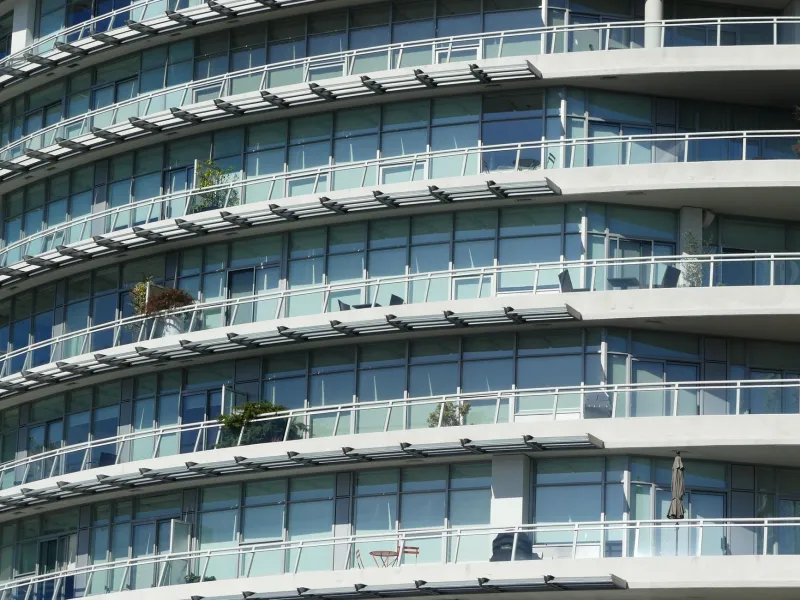
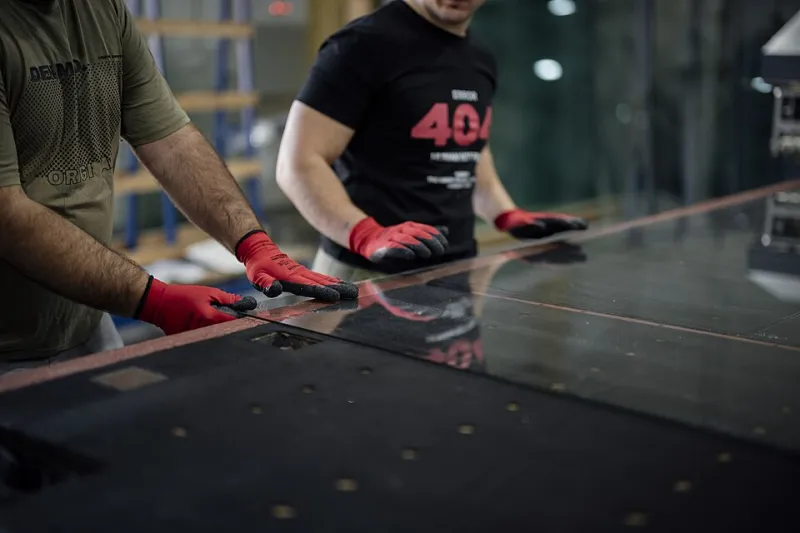
Before the Furnace or After: Why Coating Sequences Decide What Your Tempered Glass Order Can Actually Do
Photo: LapGaNaiom Bimdio, CC0, via Wikimedia Commons
Ask three suppliers to price the same storefront elevation and you may get three wildly different numbers — not because anyone is padding the bid, but because the finishes specified on that elevation interact with the tempering process in very different ways. The single most consequential question, and the one most often missed during design development, is simple: does this coating go on before the furnace, or after?
The Sequencing Problem, Explained
Tempering is the last major manufacturing step a panel endures. Glass is heated past 1,100°F and then rapidly quenched, locking compressive stress into the surface. Anything applied before that cycle has to survive it; anything applied after has to bond to a surface that can never again be cut, drilled, or worked.
That constraint sorts the common finishes into two camps.
Applied before tempering: ceramic frits and silk-screen patterns, colored interlayers (in laminated assemblies), and tinted body-tint glass, which is manufactured at the float plant rather than at the fabricator. These ride through the furnace and come out the other side permanently fused.
Applied after tempering: most low-E coatings on modern commercial units, which are sputtered onto the glass inside a vacuum coater after the panel has been cut, edged, and heat-treated. Frosted acid-etch finishes can go either way depending on the product line, but the timing changes both cost and lead time.
The practical consequence: once a panel is tempered, your options narrow sharply. A late change from clear to tinted isn't a swap — it's a brand-new production run.
What Each Finish Does to the Quote
| Finish | Typical cost impact | Lead-time behavior |
|---|---|---|
| Acid-etch frost | Moderate; adds a handling step | Often stocked in clear, etched to order |
| Body-tint (bronze, gray, blue) | Low to moderate; premium over clear | Frequently warehouse stock in common thicknesses |
| Ceramic frit / spandrel | Moderate; screen setup fees on custom patterns | Custom screens add one to three weeks |
| Low-E coated (post-temper) | Highest; coating runs are batch-based | Coater scheduling drives the calendar |
The low-E line item deserves particular attention. Coating chambers run batches, and a specifier ordering a few hundred square feet of a less common coating may be waiting for the fabricator's next scheduled run — or paying a premium to buy into one. On a project in Phoenix or Miami where energy codes push you toward high-performance coatings, that scheduling reality belongs in the construction timeline, not just the glazing spec.
Frosted and Tinted: The Deceptively Simple Choices
Acid-etched frosting looks like a commodity, but sequencing still matters. Etching after tempering preserves the option to frost only part of a panel — a gradient, a band, a logo — which is impossible with pre-temper frit. Conversely, etched-after-temper surfaces can be slightly more sensitive to handling damage during installation, a point worth raising with your fabricator's quality team.
Body-tint glass trades on availability. Bronze and gray in 1/4-inch tempered are among the most common configurations in the US market, which means short lead times and competitive pricing. Specifying an unusual tint or thickness can push you into a float-line minimum, where minimum order quantities are measured in truckloads, not crates.
The Decision Matrix for Specifiers
When weighing energy performance against cost and schedule exposure, four questions resolve most situations:
- Is the finish decorative or performance-driven? Frit and etch are design decisions; low-E is a code and HVAC decision. Don't let a decorative change order drag a performance coating into the revision.
- Can the finish survive the furnace? If yes, it locks in early and limits late customization. If no, it must be planned as a post-temper operation with its own lead time.
- What is the consequence of a field change? Post-temper coatings can often be specified on replacement lites; pre-temper frit and tint cannot. High-churn projects (retail, hospitality) favor flexible, post-applied finishes.
- Who owns the coating warranty? Coated units carry warranties from the coating applicator as well as the fabricator. Confirm both before the submittal is approved.
Envelope Performance: Where Finishes Earn Their Keep
The building envelope math is where coatings justify themselves. A clear tempered lite on a west-facing elevation in Dallas is an HVAC liability; a low-E coated insulated unit can cut solar heat gain by half or more, often paying back the coating premium within a handful of years in cooling-dominated climates. Tinted glass delivers modest solar control at commodity pricing but penalizes visible light transmission — a real consideration for retail tenants who live and die by daylight on the merchandise.
Spandrel zones — the opaque-looking panels hiding slab edges — combine the two worlds: frit applied before tempering, usually with an opacifier, delivering both the look and the code-required heat treatment in one panel.
Bring the Fabricator In Early
The most expensive finishes are the ones discovered after submittal. A fifteen-minute call with your fabricator's estimating desk — before the bid goes out — will surface which coatings they run in-house, which they subcontract, and which tints are sitting in their yard. On schedule-driven commercial work across the US, that conversation is frequently the difference between a glazing package that lands on time and one that waits on a coater two states away.