Cut Table to Curb: Where Your Tempered Glass Order Actually Spends Its Time
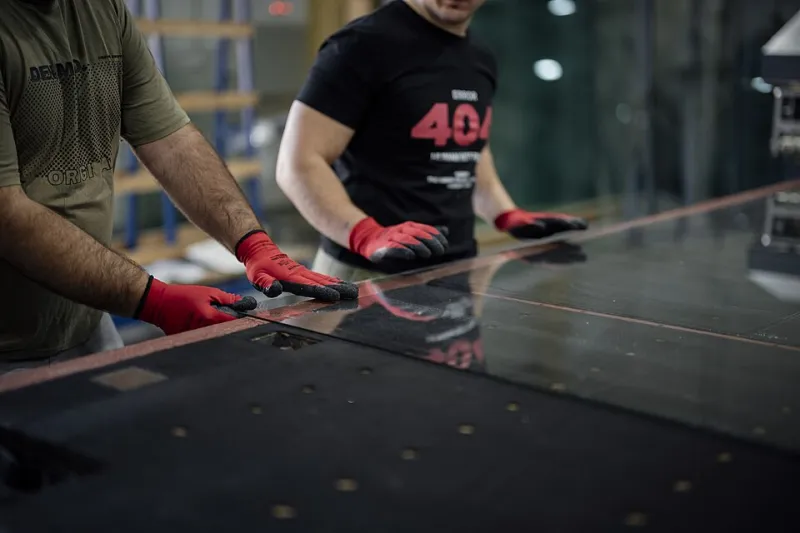
Photo: Shixart1985, CC BY 2.0, via Wikimedia Commons
Ask a project manager why a glass package arrived late and you'll usually hear about the tempering furnace. Ask why a panel arrived broken and you'll hear about the trucking company. In our experience, both answers are frequently wrong.
The reality is that a tempered glass order passes through six distinct stages before it reaches a jobsite, and each one carries its own risk profile. Understanding where the hours actually go—and where panels actually break—changes how you should write your purchase order.
Stage One: Cutting and Sizing
Fabrication begins on the cutting table, and this is where your dimensions become permanent. Once a panel moves downstream, oversize errors cannot be ground out; the piece is scrap. Reputable fabricators will double-check cut sizes against the order acknowledgment, but the burden of a correct dimensions-and-tolerances sheet ultimately sits with whoever signed the drawing.
Cutting is rarely the bottleneck, though. A typical table processes a full sheet in minutes. If your order is stuck here, it's almost always a queue problem—your job is behind forty others—rather than a machine problem.
Stage Two: Edge Work, Holes, and Notches
This is the stage most buyers underestimate. Every hole, notch, and cutout must be completed before tempering; post-tempering fabrication is not an option. That means a single missing field dimension can push an entire order back a full production cycle.
Edge quality matters here too. A coarse grind left on a panel that will later be exposed—think storefront glass with exposed edges—creates both an aesthetic issue and, more importantly, a stress concentration. Chips and shells from sloppy edging are among the most common origins of downstream breakage.
Stage Three: The Tempering Furnace
Yes, the furnace matters. Panels are heated to roughly 620 degrees Celsius and rapidly quenched with air, which creates the surface compression that gives tempered glass its strength. Furnace scheduling is where lead times are genuinely consumed: batch sizes, glass thickness transitions, and heat-soak runs all dictate how quickly your panels move through.
Distortion—roller wave, edge lift, bow—is born in this stage. If your specification is silent on optical distortion, the fabricator will produce to their standard run rate, which may not satisfy a critical retail application.
Stage Four: Quality Control
A competent QC department inspects for edge chips, surface scratches, distortion within tolerance, and dimensional accuracy. But QC is a sampling-and-judgment exercise, not a guarantee. Scratches under certain lighting conditions escape detection. Hairline edge chips that survive handling can propagate days later under thermal stress.
This is why documentation matters. If you want traceability, ask for it in writing before the order is placed—furnace batch numbers, inspection records, photographs of critical panels. Post-dispute, that paper trail is worth more than any verbal assurance.
Stage Five: Crating and Packaging
Here's a number that surprises buyers: a substantial share of breakage claims originate after the glass has passed final inspection. Improper crating—panels racked without separators, cork pads missing at contact points, crates loaded flat instead of on edge—turns good glass into a claim.
Packaging is a specification, not a courtesy. Buyers shipping long distances or through multiple carriers should specify A-frame racks for large lites, vertical packing for anything over a certain size, and corner protection on every panel. It costs the fabricator minutes and saves you a two-week refabrication cycle.
Stage Six: Freight and Jobsite Handoff
The last mile is the least controlled and most litigated. Glass rides on edge, subject to road shock, and is unloaded by people who may not know what's inside the crate. Two practices reduce risk dramatically: photograph the crate at pickup and at delivery, and refuse to sign a clean delivery receipt if the crate shows visible damage—note exceptions on the bill of lading before the driver leaves.
Phasing Orders: The Buyer's Leverage
Because stages one through three are sequential and unforgiving, buyers can protect their schedules by phasing. Release field-measured openings first and hold non-critical panels for a second release. Ask your fabricator which panels are on the critical path and request those be prioritized in the furnace queue—many will accommodate this for orders with a defined ship-complete date.
Finally, build float into the schedule that reflects reality: cutting and edging in days, tempering in a week or more depending on queue, freight across the country in another week. An order that 'should take two weeks' usually takes four once the calendar is honest.
The glass itself is remarkably consistent. It's the pipeline around it—queues, crating decisions, and handoffs—where orders succeed or fail. Buyers who understand that pipeline write better specifications, and better specifications produce fewer claims.