Quiet by Design: What STC Ratings Really Tell You Before You Order Tempered Glass
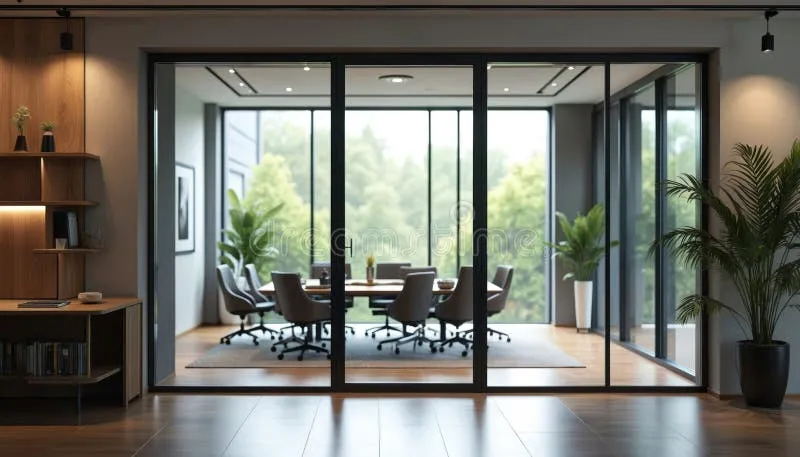
Photo: modern glass conference room partition office interior, via thumbs.dreamstime.com
Ask a glass supplier what their tempered panels do best, and the answer will almost always center on strength and safety. Ask an architect what they need the glass to do in 2025, and increasingly the answer is: keep the noise down.
Across the US, acoustic performance has become a driving specification in exactly the markets where tempered glass dominates. Open-plan offices are being retrofitted with glass conference rooms to contain meeting noise. Multifamily developers face tighter scrutiny over unit-to-unit sound transmission. School districts building flexible learning spaces want visual openness without acoustic chaos. In all three cases, the glass itself is on the hook — and buyers who treat sound ratings as an afterthought are discovering the gap between the spec sheet and the finished room.
Why the Ratings Matter More Than the Marketing
Two numbers dominate acoustic glazing: STC (Sound Transmission Class) and OITC (Outdoor-Indoor Transmission Class). STC measures attenuation of mid-to-high frequency sound — human speech, office chatter, classroom noise — and is the figure most interior specs reference. OITC weights lower frequencies more heavily and is the better predictor of performance against traffic, aircraft, and mechanical equipment noise, which matters for street-facing facades and ground-floor retail.
A standard 1/4-inch monolithic tempered panel typically lands in the STC 30s. That's enough to take the edge off a hallway but nowhere near what a private office or an STC-rated party wall assembly demands. Laminated tempered units — two lites bonded over a polyvinyl butyral or acoustic PVB interlayer — can push into the high 30s and low 40s, and the interlayer's damping properties do much of the heavy lifting at frequencies where monolithic glass struggles.
The critical buyer takeaway: tempering itself adds essentially nothing to acoustic performance. Heat-treating changes the strength of the panel, not its mass or damping. If your quote lists "tempered" as the acoustic solution, read the STC number carefully — it's the laminate build-up, the thickness, and the air space (in IGUs) doing the work.
Where Acoustic Performance Gets Lost in Fabrication
Even a well-specified laminate can underperform if the fabrication details aren't coordinated early.
Edge work. A polished or flat-ground edge on a frameless acoustic partition isn't just cosmetic. Exposed, unsealed edges can create flanking paths where sound leaks around the panel entirely. For frameless installations, specify edge treatment and gasketing as a system, not as separate line items from the glass supplier and the partition hardware vendor.
Thickness jumps. Doubling glass thickness doesn't double attenuation — mass law predicts roughly 6 dB per doubling, and real-world gains are often lower. But stepping from 1/4-inch to 3/8-inch monolithic, or moving to a 1/4-inch over 1/4-inch laminate, frequently costs less than buyers expect and buys measurable performance. Get the incremental pricing before defaulting to the thinnest panel that meets the safety code.
Asymmetry and airspace. In insulated glass units, using lites of different thicknesses — say, 1/4-inch laminated outboard over 1/8-inch inboard — disrupts the resonance behavior that lets matched lites pass sound. It's a standard trick in commercial fenestration that interior spec writers sometimes miss.
Paying for Performance You Won't Get
The most common failure mode we see in quotes is a mismatch between the tested assembly and the installed one. An STC rating belongs to a specific configuration — exact glass make-up, framing, seals, and mounting. Substitute a stock tempered panel for the specified laminate to hit a budget, and the rating on the submittal no longer describes the product in the wall.
Buyers should also watch for ratings quoted from laboratory testing of laminated glass without accounting for framing. In field conditions, realistic performance typically runs 5 to 10 points below the lab number. Design to the field figure, not the brochure.
What to Put on the Next Quote Request
For procurement teams, the practical checklist is short:
- Request the STC and OITC rating for the exact build-up quoted, not a family of products.
- Specify laminate interlayer type (standard PVB vs. acoustic PVB) when sound is a driver — the price delta is modest and the performance delta is not.
- Coordinate edge finish and gasketing with the partition system manufacturer before fabrication.
- For facades, confirm whether the project's acoustic consultant is working to OITC targets, and verify the IGU configuration supports them.
Tempered glass will remain the safety-glazing workhorse in these applications, and that isn't changing. But the market is signaling clearly: buyers are no longer asking only whether the glass will hold up — they're asking whether it will hold its tongue. Suppliers who can document acoustic performance with tested data, and fabricators who protect that performance through edge and installation details, are the ones winning these specs.