The Distortion We've Learned to Accept: Why Roller Wave Tolerance Needs a Rethink for Modern Retail Glazing

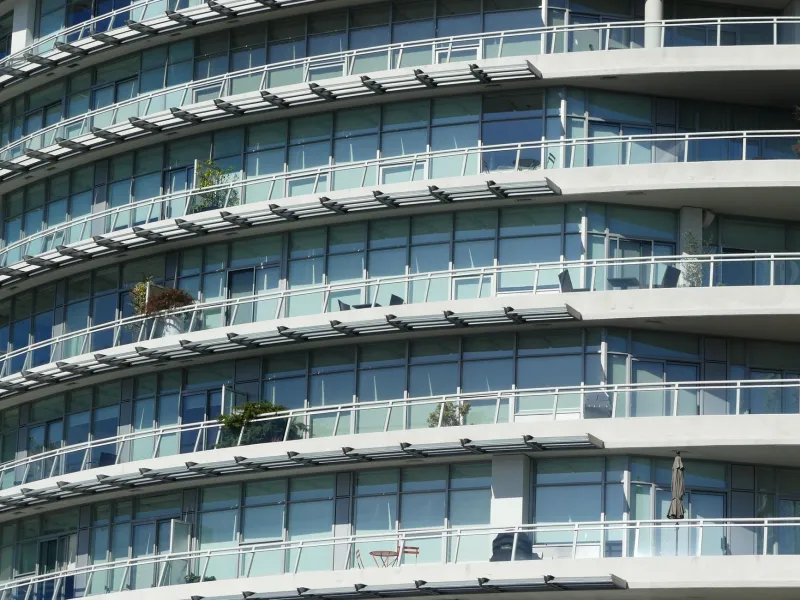
Photo: PattayaPatrol, CC BY-SA 4.0, via Wikimedia Commons
Stand somewhere on a busy American retail corridor — think the outdoor malls of Scottsdale, the mixed-use streetscapes of Austin, anywhere developers are stacking glass-front restaurants three stories tall — and look at the glazing. Chances are good you'll see it: that faint horizontal ripple reflecting the building across the street, the subtle banding that makes a mannequin or a liquor shelf seem to wobble as you walk past.
The industry has a name for it — roller wave — and a standard that says it's acceptable. We'd argue the standard is showing its age.
What Roller Wave Actually Is
In horizontal tempering lines, glass rides on ceramic rollers through a furnace at roughly 1,150°F before rapid quenching. Soft glass plus gravity plus rollers equals a faint periodic corrugation — typically a peak-to-valley deviation measured in thousandths of an inch over a twelve-inch span. ASTM C1048 permits roller wave of 0.005 inches for most heat-treated lites when measured per the standard's method, along with limits on overall bow and edge kink.
For decades, that tolerance was fine. Glass was greener, thicker, and usually set in frames with mullions every few feet. Distortion had nowhere to register visually.
Why the Old Tolerance No Longer Works
Three market shifts have changed the math:
Scale. A 10-foot-tall, 6-foot-wide storefront lite amplifies any waviness. The same deviation that vanished in a 1970s shop window dominates a modern full-height facade.
Optics. Low-iron glass, widely adopted for high-visibility retail, removes the green cast that once masked perceived distortion. Clearer glass makes waves more apparent, not less.
Configuration. Heat-treated lites in insulated glass units, especially with reflective or low-E coatings, turn roller wave into a funhouse-mirror effect. Coated IGUs also introduce their own optical artifacts, compounding the problem.
The result is a widening gap between what the standard permits and what an owner will accept. General contractors increasingly find themselves mediating between a fabricator pointing at C1048 and a retail tenant pointing at their own reflection.
Closing the Gap Contractually
The specification, not the standard, is the right place to resolve this. Buyers on distortion-sensitive projects should:
- Tighten roller wave limits in the spec — 0.003 inches or less is achievable and commonly quoted for premium horizontal-temper work; vertical tempering or stress-scoped processing can go further at a premium.
- Demand sample panels or mockups for signature elevations, reviewed at the actual viewing distance and lighting.
- Consider alternates for the worst exposures: annealed laminated lites where code permits, or heat-strengthened glass where the application allows a lower safety factor.
- Define measurement methodology in the contract — where the gauge goes, in what light, at what standoff — because "looks wavy" is not an enforceable rejection criterion.
Inspect on the Truck, Not the Wall
The single most expensive mistake in distortion disputes is discovering the problem after glazing is set. Once a panel is installed, sealed, and possibly backlit by the tenant's own signage, replacement involves demolition, remobilization, and schedule loss.
A practical receiving inspection takes minutes per crate:
- Stand panels upright, angled against a flat, shaded surface with a uniform reflection — a flat garage door or a smooth pavement works.
- View from 10 to 20 feet at a slight angle, scanning for periodic ripples along the horizontal axis.
- Run a straightedge and feeler gauge across suspect zones if a contractual limit is in play.
- Check edge kink by sighting down each edge before the panel leaves the crate.
- Photograph and document any rejection immediately, with the delivery ticket in frame.
Panels that pass on the truck will look the same on the wall. Panels that fail on the truck are a freight claim, not a construction claim.
The Bottom Line
ASTM C1048 remains the right baseline for structural and safety performance — nobody is suggesting it be ignored. But optical quality in high-visibility glazing is a commercial variable, and the market has already repriced it. Owners and specifiers who treat distortion as a specified, inspected, contractually bounded property will get the storefront they imagined. Those who rely on a 1990s tolerance will get exactly what that tolerance allows — and they'll see it in every reflection.