Stop Over-Tempering: Why Heat-Strengthened Glass Deserves a Second Look on Your Next Quote
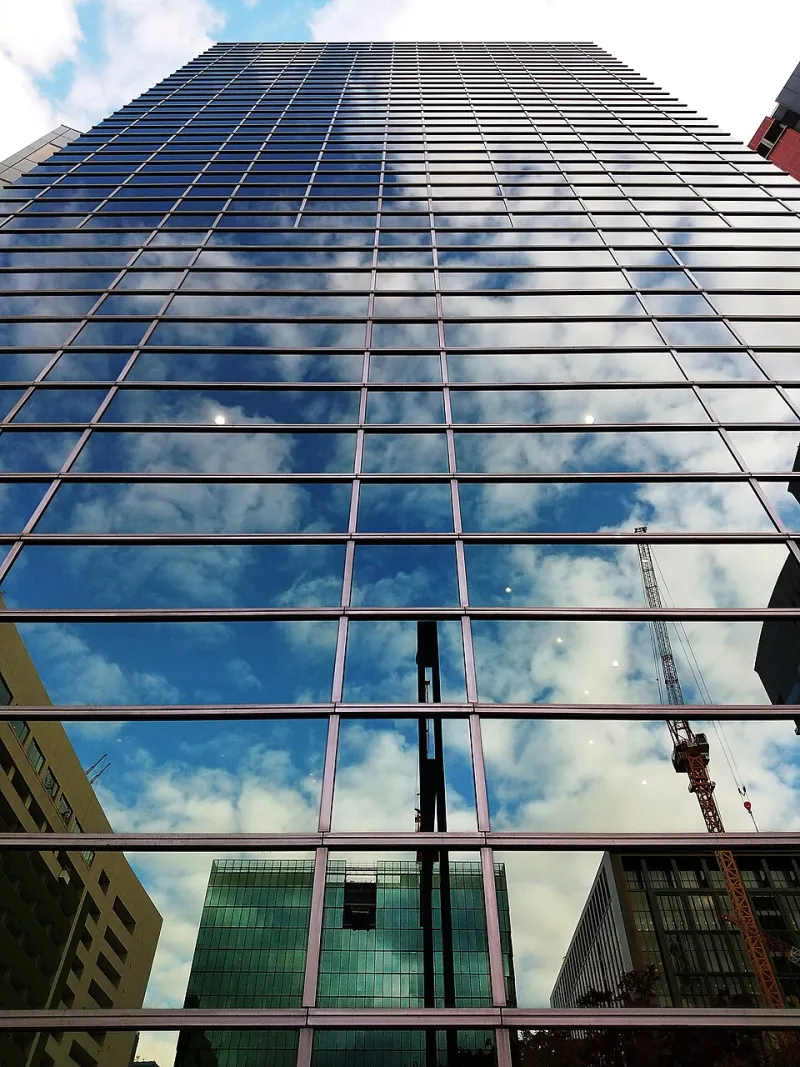
Photo: Hirho, CC BY-SA 4.0, via Wikimedia Commons
Somewhere along the way, full tempering became the reflex answer on US glazing specifications. If strength is good and tempered is strong, the logic runs, temper everything. The result is a quiet pattern of over-specification: panels tempered where the code never demanded it, budgets absorbing fabrication premiums, and curtain wall elevations showing the telltale roller-wave distortion that full tempering leaves behind.
The argument here is straightforward: heat-strengthened glass is the correct product for a large share of applications where tempered is currently specified, and buyers who understand the difference hold real negotiating leverage.
Two Products, Two Strength Profiles
Both heat-treated products start as the same float glass and pass through the same furnace. What differs is the quench.
- Fully tempered glass is quenched aggressively, producing a surface compression of at least 10,000 psi. It is roughly four times stronger than annealed glass of equal thickness and, critically, it fails into small granular fragments rather than sharp shards — which is why safety glazing codes require it in doors, sidelites, and other hazardous locations.
- Heat-strengthened (HS) glass receives a gentler quench, targeting surface compression around 3,500 to 7,500 psi. It is approximately twice as strong as annealed glass. It does not meet safety-glazing fragment standards — it breaks in a pattern closer to annealed glass — and it is not a substitute for tempered where safety glazing is mandated.
Neither product carries a formal industry tolerance for bow and warp the way many assume; HS glass simply distorts less because the lighter quench induces less strain. On a large vision panel, that difference is visible from the sidewalk.
Where Each Product Belongs
The distinction maps cleanly onto real project conditions:
Tempered glass belongs in: doors and sidelites, windows within 18 inches of a walking surface or within the zone near stairs and ramps per IBC 2406, shower and tub enclosures, glass railings, and any location where human impact is foreseeable. When tempered is used in insulating units in high-wind or high-heat-gain exposures, remember that tempered panels fail at lower temperature differentials than HS — a genuine thermal-breakage consideration on spandrel and southern-exposure units.
Heat-strengthened glass belongs in: insulated vision units in curtain wall and storefront systems, laminated construction where the interlayer provides safety performance anyway, structural silicone-glazed elevations, and any elevation where optical flatness is a stated aesthetic requirement. When laminated, HS glass delivers the safety-glazing compliance the code requires without the distortion and thermal-breakage sensitivities of full tempering.
Spandrel is the interesting middle ground. Opaque ceramic-coated or fritted spandrel panels hide distortion better than vision glass, which is why some fabricators default to tempering there. But spandrel units also run hot — dark coatings in a sealed IGU can push temperature differentials well past what annealed glass tolerates. HS or tempered, the panel must be engineered for the thermal load; the point is that the decision should be made deliberately, not by habit.
The Cost Math Buyers Should Run
Full tempering typically carries a fabrication premium over heat strengthening — modest per lite, meaningful across a 2,000-panel elevation. Add two more line items tempering quietly imposes: a higher thermal-breakage allowance during construction and occupancy (tempered fails at smaller temperature differentials), and occasional spontaneous breakage risk from nickel sulfide inclusions, which is essentially absent in HS product because its core tension is far lower.
A Checklist for Reviewing Quotes
Before signing off on a glazing package, ask the bidder:
- Which lites are specified tempered, and does each one actually fall within a code-mandated safety-glazing location under IBC 2406?
- Where laminated units are used, is the glass heat-strengthened behind the interlayer rather than tempered by default?
- Has thermal stress been calculated for spandrel and high-exposure units, and does the heat treatment match the analysis?
- What distortion tolerances — edge lift, roller wave, overall bow — are committed in writing for vision glass?
- Does the quote separate HS and tempered pricing so the premium is visible?
None of this argues against tempered glass where it's earned its place. It argues against paying tempering prices — in dollars, in distortion, and in breakage risk — for panels that never needed it. On the next bid set, make the spec justify the heat treatment rather than defaulting to it.